Transformative Technology, Spirituality & Measuring the Human Experience
How technology can improve and remind us of our humanity

I feel ridiculously fortunate to live in San Francisco, with access to events, ideas, and people that are supported by deep research, practical knowhow, and entrepreneurs pushing the edge. Last weekend, I attended the Transformative Technology Conference, held at Sofia University in Palo Alto.
I felt a bit like a dolphin trying to swim the desert insomuch that everything was new, including the realization that there’s an entire group and community formed around technology that’s asking the deep questions about our humanity, what we should measure, the implications of technology, and the nature of the universe.
There’s a whole slew of “consciousness hackers,” as they call themselves. The common thread seems to be a deep curiosity about how our mind, body, and spirit work together, alongside a deep desire to measure and bring the intangible into tangible form so that we might be able to understand the full spectrum of life, better.
The conference was a full three days and I popped in and out the first two days, spending some time in the exhibit hall, testing gadgets.
The main talks I attended had overlap with my work in following the progression of technology and the future of work, touching on subjects like artificial intelligence, wearable technologies, and brain science.
I can safely say, this conference offered the first glimpse into sensing my own techno optimism. When speaking about artificial intelligence, Dr. Mohamad Tarifi, who leads an A.I. engineering team to Google, spoke about the technology that’s coming, the capability and exponential acceleration of this intelligence, and what’s possible now. If you don’t know, A.I. can create images of people, compose music, and even films.
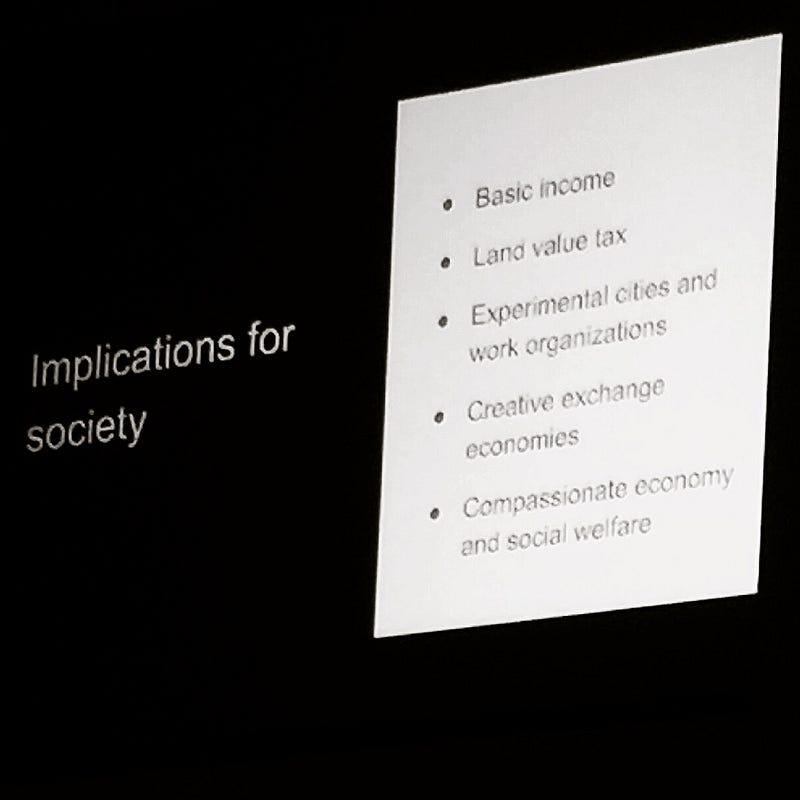
The thing I found most surprising was Dr. Mohamad’s focus on being an artist and continuing to explore the creative aspects of life as a vector for creating value in the new world order. To follow on, he spoke about the economic implications and fallout, with well thought out answers to social problems that are coming… some of his solutions included things like basic income and international networks of creative economies.
How did I end up at this conference?! After several related conversations on recent trip to NYC, I gravitated toward wanting to understand the intersection between technology and fully realizing our inner wisdom. First, I met Jason Kende who spoke about VR augmented empathy, using war zones as an example of where people might develop a deeper empathy and compassion, even disgust with what happens in the world, especially the virtual reality experience could make a person feel like they are actually there — witnessing the experience through the eyes of another.
This was followed by a long chat with a friend who is part of the consciousness hacking community, who gave me the needed push to pursue these threads — along with a testimonial about the resonance I’d likely feel with the people involved.
He was right.
Ok, back to the conference.
On another panel, Judith Pennington spoke about the mind mirror, which allows you to see a map of your brain in real time, and moves with you as you move, to show you which parts of your brain are lighting up, overlaid on top of a video image that follows all of your movement. She spoke a lot about the depth and profundity of reaching and experiencing the intuitive mind, stating that we don’t have to stop at meditation — there’s more, she said.
“If we can take the plunge into low enough frequencies to go into theta, one can come into incredible coherence — where a reset can be done, and whereby what the brain learns, it holds onto what is taken in, going deeper each time.”
The delta brainwaves are where we experience empathy, she explained.
After all of that, I headed to the exhibit hall, which was not a typical series of booths and sales people. Instead, these were scientists, storytellers, tinkerers, doctors, and more offering devices that ranged from the Muse heart rate monitor for meditation, which measures your brainwaves to train focus, to virtual reality headsets, and infrared heating pads.

What tripped me out about the Muse was that it wasn’t trying to get you into a theta state or even a relaxed state, but rather a focused one. Basically, you sit down, put this headband behind your ears, and start the app, which is hooked up to headphones. You follow the prompts and in this particular version, you’ll hear more stormy waves when there’s a lot of brain activity, more calm waters when there is less, and birds when you’re focused.
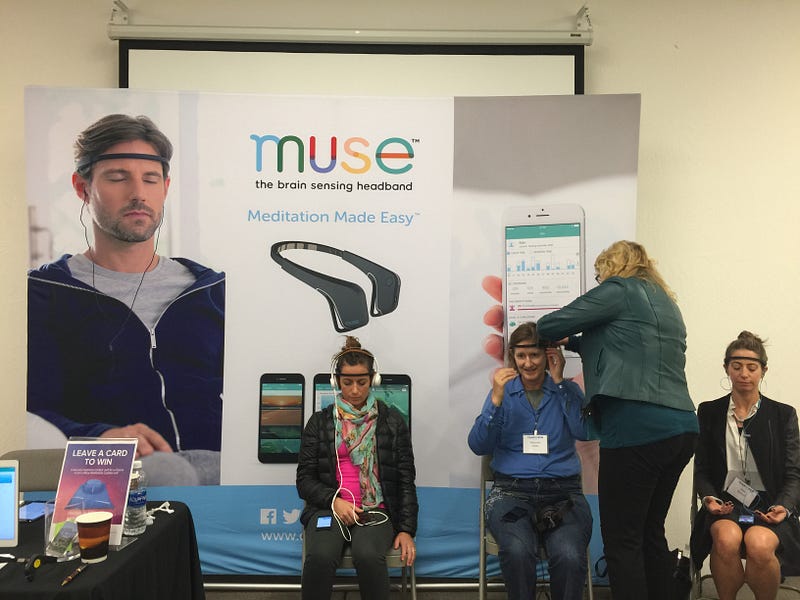
When I questioned them about how it worked — as in specific brain waves measured, I got a sort of defensive response about that being the secret sauce of sorts. As in, they don’t tell you, which sort of defeats the purpose in a way, especially if you’re interested in training for a theta state. Though, I did find the price point pretty reasonable at $249.

The interaction I had with Muse was in stark contrast with a gentleman I met outside on the first day. Mr. Joel Murphy and I shot the breeze on the merits of being outside, and dancing in the rain — moving onto his OpenBCI technology, an open source brain computer interface for measuring EEG, EKG, and EMG. Wow! The technology his team created (BTW, Joel has a background in fine arts), is supported by the hardware they sell. And the contribution OpenBCI offers to the consciousness hackers is huge. Many of the makers in the community and beyond build on top of OpenBCI.
Up next, I met Jen Healy, who was giving an informal presentation (she’s in purple in the photo below) in the exhibit hall to a potential collaborator with a complementary technology.
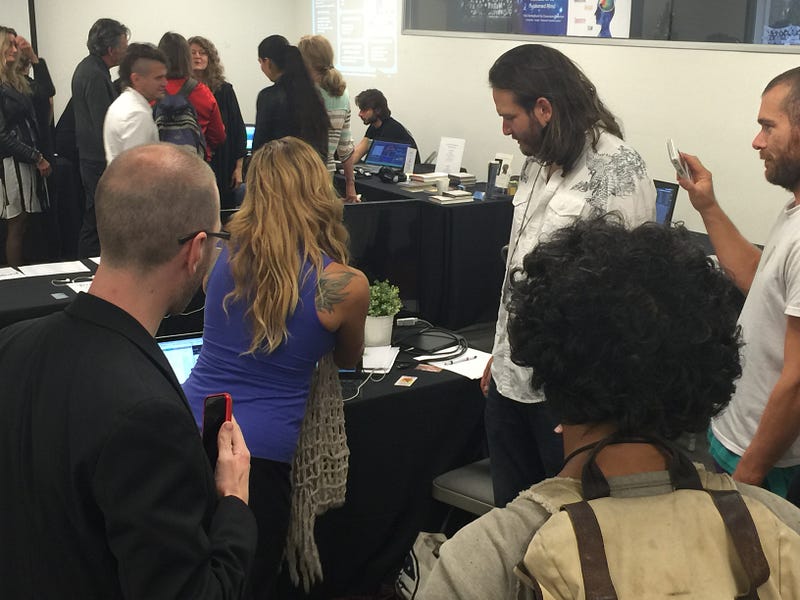
She had the coolest hair — did you know that you can get streamers woven into your hair to look a bit holographic? I loved her explanation of energetic healing work because it included an NES scanning system, which shows where you have weakness or energetic blocks in the body. She was explaining that she can see them without the software, but that it grounds her work for her patients.
I had several other soul diving and otherwise significant learning conversations, but I think I’ll stop there!
Overall, I learned that I need to pay more attention to the work people are doing on the front lines of technology from a collaboration, heart centric approach — this very much overlaps with my work and my interests.
If we can use the technology we build to understand how we are built and improve our cognitive and empathetic capacities, this will be a key part of generating an economy which values sharing, collaboration, co-creation, and creative expression — as well as peace, equality, and community, which weave the emergent ecosystem together.
To learn more, follow on and convene through these people and groups:
Consciousness Hacking
Transformative Technology
Ken Wilber’s Blog
Mikey Sigel’s Blog
A big thanks to Nicole Bradford for making it possible for me to come to the Tranformative Technology Conference. Check out her transformative technology company, Willow Group.
Chelsea Rustrum, author of It’s a Shareable Life and founder of Sharers Talks series is a consultant for the new economy, helping new companies with strategy and existing companies understand the economic shift we’re undergoing. She also speaks internationally on the topic of Moving from a Sharing Economy to a Shared Economy, citing many examples and economic trends. Get in touch!