The Next:Economy — An Economy of Shared Value
Summary of What New Economy Leaders are Saying & Doing
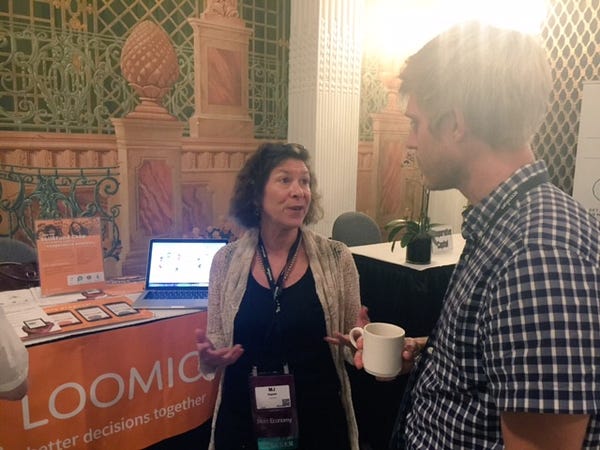
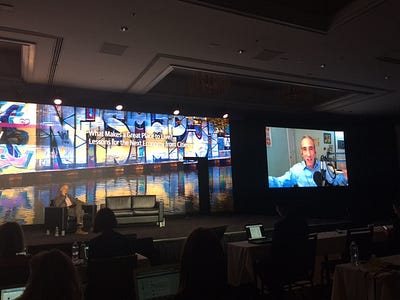
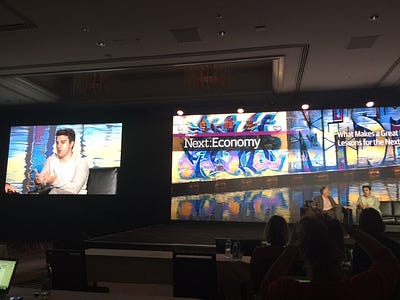

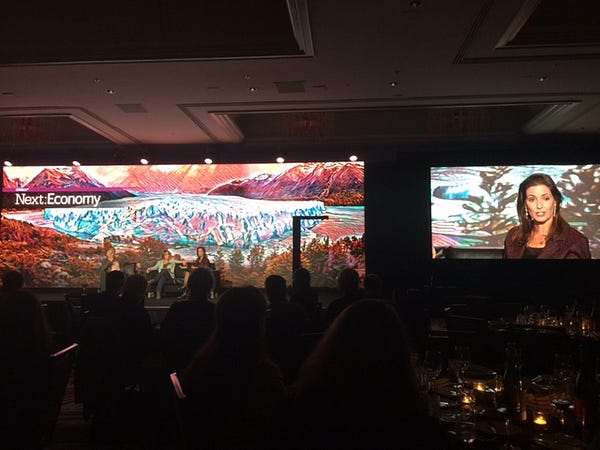
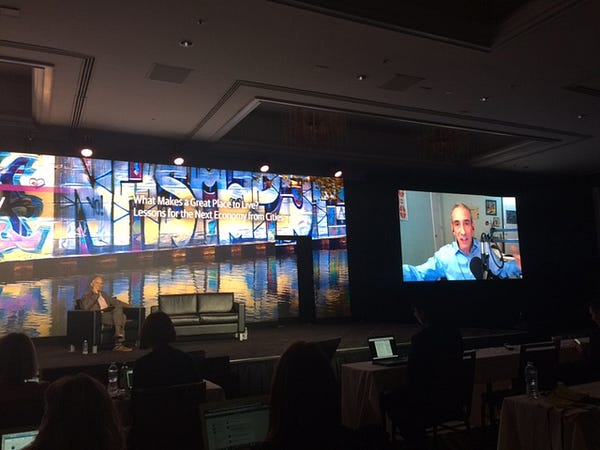
With just a couple hundred people at maximum and a sticker price of $3,000, with some of the best minds, especially where the sharing and collaborative economy are concerned, I considered it my duty to do a write up on what was said, including my own reflections.
Although, the conference was still held in windowless conference rooms and had a very serious, corporate vibe — the speakers were full of insight, wisdom, and actionable results in their respective organizations. I’m sure I’m not alone in saying that the conference was truly inspiring.
If I had one takeaway for the those of you that TL:DR, my conclusion would be that corporations are starting to think about their role with shared value, equity, dividing into smaller divisions, working more cooperatively, and thinking through their role in the new economy as things necessarily shift, move, and change — mostly led by nimble organizations that are pushing the envelope on what’s possible and absolutely necessary for humanity.
UBI
One of the first talks that I wrote notes on was that of the topic of UBI (universal basic income). So far, I’m still not a huge proponent of this idea even though I believe in the basic tenant of people having access to resources. If socialism is about dividing up resources and capitalism is more about free markets, I’d like to see something in between. People still need to work or to self express. And I believe if we distributed value better through business, UBI wouldn’t be a default conclusion to the acceleration of technology.
That’s another thing. Not once did ANYONE admit that technology is going to absorb a shit ton of jobs. There’s this glossy optimism that’s just not realistic that echoed throughout the event. Event the guy I was sitting next to, an engineer for Tesla’s self driving car division was shaking his head in disagreement.
Back to UBI…
I like the idea of calling universal basic income the “ultimate seed fund,” which is something I hadn’t previously heard, followed by statements about how if you think economic security is a human right and want to solve poverty you need cash to get there. I tend to agree with that, but I also think there are a number of ways to get there. I’m leaning more toward the idea of basic income for certain individuals for a period of time, but not as a default.
And finally, Tim O’Reilly asked the question that’s been burning in my mind for months, why is Ycombinator so interested in UBI? Elizabeth Rhodes, hired as a researcher for Ycombinator responded with details about how technology could put people out of jobs and there could be a future were we need a different distribution of resources.
Ahem… THAT’S NOW.
Author Andy Stern had some great one liners — a few that will stick in my mind.
“Change is inevitable. Progress optional.
What does a world look like with less work? Hunger games or the top level of Maslow?”
Patreon
Next up, Patreon. I have a few friends that work at Patreon and others that use this platform for earning money for their artistry or creative endeavors. But, I had no idea how big Patreon already is or how far reaching the implications are… Jack Conte realized that he was making videos and posting them to Youtube, having millions of views, but only earning $160 per month. So as a test, he built Patreon in the period of a few weeks with some friends. Almost immediately, his income went from $160 a month to $5,000. Oh, and did I mention that Patreon is a way for fans to voluntarily pay creators?
According to Jack, there are 25,000 people making a living on Patreon. He spoke about a small video team that came onto the platform barely making anything on Youtube, thinking they’d probably max out at $5,000 who made a whopping $25,000 in first month and now they are a full on small media production company, funded through patronage. I especially liked this answer from Jack, when quizzed about how Patreon is different from something like Kickstarter, “You’re paying for people — not for stuff.”
Later in this session, Tim said something I hadn’t heard before, but liked calling out platform capitalism as a thing.
Fohr Card
Next James Nord, the very well dressed, well spoken founded of Fohr Card spoke, though I wasn’t totally sure what he was trying to say besides millennials are annoying, finicky, and spoiled — though, he didn’t even look old enough to be outside of the millennial age range. His company offers other companies access to so-called influencers… these are typically kids with huge social media followings who get paid in trips, flights, and clothes to travel the world in style because other people listen to their opinions.
The sharp contrast between James and Jack was striking. I felt a bit of a knot in my stomach as he spoke, really hoping that he was moving us in a direction of thought that would be additive, keeping us in suspense in the process.
He did end on a thoughtful note:
“The digital 1% live at highest levels of luxury without money. They trade for what they want in their lives. They fly in private jet by trading Instagram posts.
How does the world arrange itself, if not with money?”
Uber
I suppose the next speaker was in the perfect spot of this lineup. Rachel Holt, who runs operations for North America at Uber towed the party line. She spoke about how drivers aren’t paid less than they used to be and are driving more, so even if they are making less, they are paid for more of the time they are in the car, making it a sort of wash.
Rachel also touted statistics such as 1/3 of Ubers drivers have full time jobs and another 1/3 of them have part-time jobs, in addition to driving. I’d love to see how they arrived at these stats, would be great to have more transparency around these numbers…
When questioned about things like fingerprinting, Rachel spoke about how this practice is discriminatory for drivers, also saying that fingerprinting was not designed for employment purposes.
Rachel also mentioned how many drivers are now using driver destination, which enables drivers to pick a destination such as their home or final evening destination and pick up riders along the way. When Tim questioned her if people use this similar to the way that Blahblah Car or for longer trips, she said that drivers are mostly using it on their way home.
Up next was the question that we’d all love an answer to. How do you reconcile what you’re doing with self driving cars?
Rachel spoke about saving millions of lives — saying we should all strive for this, talking about how safe self-driving cars will be compared to human error. She also said a self-driving future is still a ways off and that we’ll need drivers for things like Uber Eats.
The guy from Tesla next to me snickers in obvious disagreement.
She also spoke about how Uber is entering interesting partnerships with public transit in different cities including in New Jersey and some parts of Florida, where Uber trips are subsidized to get people to downtown areas.
Thank god Douglas Rushkoff was next. He’s such a breath of fresh air. If you haven’t read his newest book, Throwing Rocks at the Google Bus, How Wealth Became the Enemy of Properity — you need to! I interviewed him in front of a live audience earlier this year, and you can watch here.
Since I entered the room middway into this session, I really only heard him talk about how he tried to get Uber to create a 10% equity pool for drivers. In my mind, it’s just a matter of time before all companies will be required to think about shared value.
Shinola
The next talk I saw was with the founder of Shinola, a Detriot-based watch maker who retrained a workforce used to making cars to manufacture fancy watches. To be honest, Tom Kartsotis seemed either bored or tired.
Tom is definitely a forerunner and a pioneer, but he didn’t seem to like to be painted that way. The first watch they created was basically crowdfunded through an ad in the local newspaper. And in their first year, they made 55,000 watches. I found him inspiring even if he didn’t think he was!
Thumbtack
Since I know a lot about Thumbtack from using it, I listened while working during this session.
A few of the tidbits I found interesting:
- Liquid marketplaces are a big part of the future of work
- They could easily build supply without demand in new cities because freelancers and consultants, especially in the home improvement and event services space need help marketing themselves
- They have 250,000 providers across 1,000 categories
- Amazon and Google are now competing in these markets, but it will take a big commitment on their part to build this locally and that’s not currently what they are setup to do.
Pokemon Go
John Hanke, founder of Pokemon Go, has to be one of the most interesting people in the Silicon Valley. He’s been working on mapping for much of his career at Google, then Google Earth, more recently layering in augmented reality and the games Ingress and now Pokemon Go.
John kept referring to “virtual creatures” and the way he said it, almost made them sound real.
Sounds like they’ve gotten some phone calls from the government because virtual monsters were appearing in areas of endangered species and people were trampling dunes. The beautiful thing is, it’s easy to redirect people… so that wasn’t that big of a deal, just some quick changes to the code.
John talked about resurgent neighborhoods and the use of Pokemon Go in cities to direct people to go to go where they wouldn’t ordinarily go — that’s a big power. It will be interesting to see how cities work with augmented reality in the future.
For those of you that don’t know and have been living under a rock, Pokemon Go turns the world into virtual game board with virtual creatures and gems overlayed onto real world. Get kids outside of the house and into parks.
When asked about how he saw augmented reality playing out over time, John talked about some concerns:
We’re going to live in world where augmented reality is commonplace, part of everyones perception. There will be haves and have nots — access to technology, certain services offered in some venues, and those who will be let in and those who will not.
In closing, John spoke about a partnership they are looking at doing with the Knight Foundation to work with cities — building and rebuilding parks.
Airbnb
I’ve seen Brian Chesky from Airbnb speak more than a dozen times in the past 6 years, all over the world. This time, he had a slightly different message.
Brian spoke about what he usually does with Airbnb, but added to that was a large emphasis on building a village lifestyle into cities, a move away from chains and back to mom and pop venues, and a idyllic vision of Airbnb can play a role in that.
I thought it was funny that Brian made a joke to Tim about inviting him to hotel (the conference was at the Westin St. Francis) to talk about Airbnb. Brain’s idea is that a conference should be in a theater — everything else in homes. I tend to agree!
Brian spoke a lot about cities and communities saying:
A city is a community. Communities are made of people. If you know who people are — you can do so much to connect them.
On one side of the coin, there will be more automation he said. But on the other, cities will look more like villages. Brian said we’re already seeing this… more affluent city dwellers prefer to shop in farmers markets. And then he made another joke, this time about the future starting to look like th past. Actually, my good friend Peter Yared wrote about this trend years ago in Venture Beat.
One thing that stuck out was this one liner, that I tend to agree with:
“The sharing economy isn’t ending — it’s just beginning.”
He went on to talk about how Airbnb policy issues and how working with cities has been for the organization. Apparently, every city wants something different. For example, San Francisco wants to keep hold on housing while Tokyo wants more commercial activity, so Airbnb works city by city to help with local initiatives and that seems to be the best way forward.
Brian said there are currently 3 million houses listed on Airbnb — wonder how many hosts?! (There wasn’t a Q&A period for the whole of the conference). With 3 million places, Airbnb has had over 100 million guests.
Another staggering stat, “an estimated 13 million homes sit EMPTY every day.“
The rest of the conversation was about integrating Airbnb into cities and how transparent they can / want to be. He said that cities should thinking… Airbnb is an opportunity — how can we best harness it?
Brian talked about Airbnb Open, happening in 5 weeks in Los Angeles (last time it was held in San Francisco).
To end Brian repeated what he said early about remapping cities to look more like villages and then offered this:
“We should be extremely optimistic about the future. Tech doesn’t need to leave people behind. When tech becomes part of cities, we can make such a better future.”
Pol.is
Colin Megill has some brilliance to add to decision making, which includes find out just as much about what people agree on, as where they differ. Pol.is clutters opinion groups and looks for consencus, which is especially useful for large groups and decision making in on the civic level.
Check out what they are doing in Taiwan.
IBM
I’m pretty sure IBM was a sponsor, but Jeff Smith had some beautiful things to say about leadership and structuring large organizations.
If we can break down 400k people and move 40,000 groups of 10 — can get scale of best tech companies.
Followed by, the age old, “Leaders job is to get out of way.”
People don’t learn in big chunks — they learn in segments. Practice with your team.
The Human Handbook
Sara Holoubek had me the second she stepped on stage. While I lost my notes for this session, I was so impressed that I also tweeted about her talk. Her point is basically that if you treat people like the human beings that they are and value them, they will be happier and perform better as a result.
She gave a zillion corporate examples of paid leave and the like and talked briefly about how she’s implementing some of these through Luminary Labs, which is an innovation consultancy that likes to work with “big, messy problems” as she puts it.
“Corporations are rethinking how they design businesses to create value.”
The The Human Design Manifesto, which outlines ideals for human-favorable policies including establishing livable wages, developing creative equity plans, offering paid parental leave policies, and even pulling out of an entire state in protest of discrimination.
Hell yah!
Mayor of Oakland
Mayor Libby Schaaf is a fun, super smart firecracker. She spoke at the dinner in the evening of the first night, after a full day of programming. So, I’m sure she had a tough crowd.
She’s the real deal. Full of life, insight, and grounded optimism. She spoke about Uber coming to Oakland and how that could be a good thing as long as Uber integrates with the existing community. She mentioned that many of the vendors for Uber will be local restaurants and providers, including one deal already sealed with local coffee shop cooperative, Red Bay Coffee.
A central theme of the conversation was:
How do we mix tech with ethos?
Later in the conversation, she mentioned several key initiatives that the city of Oakland is taking on, looking at a long term horizon, including $500 college savings account for kids born into low-income households, with the aim of tripling the number of college graduates in this group.
I’m a fan. She’s fantastic. And on it.
Indie VC
Bryce Roberts a well known VC started a small seed fund, which includes lots of of tools and acceleration for startups who don’t need or want to take on a lot of capital, keeping companies small and focused on sustainability from a financial standpoint. His new fund is called Indie VC.
I will be looking forward to see what they invest in, as there’s not much info currently on their website.
Bernie Campaign
The Bernie Sanders campaign was legend, so senior campaign advisors Becky Bond and Zack Exley aren’t giving up. Instead, they are open sourcing the lessons learned in the Bernie Sanders campaign to layout a complete plan for rebuilding the economy, for hitting the reset button.
Zack in particular was very opinionated and unafraid to lay it down as he sees it. And Beck talked about getting people to do the big things verses small asks.
“People are not willing to do small things if there is going to be a small outcome.”
Tim offered a great quote in the middle of the talk, after asking the question — what can a loser teach us about winning.
“We want to be defeated by successively better beings.”
So these two, Becky and Zack are writing the Rules for Revolutionaries, and one of the rules is:
THE FUTURE WILL NOT BE STAFFED.
One of the lessons these two learned during the campaign was to decouple volunteer power from staff. At first, they tried an online campaign with a button that read, “Click here to start making calls.” The response for that was miniscule. So the two thought through a design flow that would keep people committed to one another, versus to them.
Instead of the click to call campaign, they got hundred of campaign organizers in a room together and asked 10% of the room to volunteer to be a group leader. That was easy, what followed was getting the rest of the crowd to volunteer to commit to the campaign leader. When people commit to one another, to another human — it just works because people don’t want to let their leader down.
DoNotPay
Joshua Browder, at 19 — captivated everyone and got a standing ovation. He is a brilliant speaker and has an inspiring mind. It’s safe to say that he was a crowd pleaser for a number of reasons, including his work, ethos, and humility.
DoNotPay is a robot (bot for short) lawyer for parking tickets.
He said that lawyers laughed him out of their offices when he asked them if they thought legal issues such as parking tickets could be fought with bots. He’s since proved them very, very wrong.
After figuring out that he could fight parking tickets with robots, he moved to fighting for peoples rights with airlines when passengers are left stranded to pay their own bills when it’s the fault of the airline. He offered this service free of charge.
Joshua said that the United Kingdom has a really broken system whereby homeless people have to see highly paid lawyers in order to get help as a homeless person. His system allows homeless people to automatically claim resources automatically without the need to pay or even use a lawyer.
Now Joshua is rolling out DoNotPay to use with housing issues, including deposits that are not returned.
And good news, most of the services created by DoNotPay are available in the UK, but as of this week, will also be available in San Francisco.
One of the things Joshua said in closing is that:
Bots will make the government have to work more efficiently.
My Favorites
In the end I met with, listened to, and saw a lot of companies building truly innovative initiatives, business structures, investment funds, and cooperatives.
Here are a few of my favorites:
Kwaku Osei — The Cooperative Capital Fund in Detroit
Sara Holoubek — The Human Handbook, Luminary Labs
Bryce Roberts — Indie VC
Jack Conte — Patreon
MJ Kaplan — Loomio
Matt Jorgenson — Josephine
Colin Megill — Pol.is

Chelsea Rustrum, author of It’s a Shareable Life and founder of Sharers Talks series is a consultant for the new economy, helping new companies with strategy and existing companies understand the economic shift we’re undergoing, whilst remaining competitive. She also speaks internationally on the topic of Moving from a Sharing Economy to a Shared Economy, citing many examples and economic trends. Get in touch!